
The Numbers First: a KRW 20 Billion Record High and the Gap
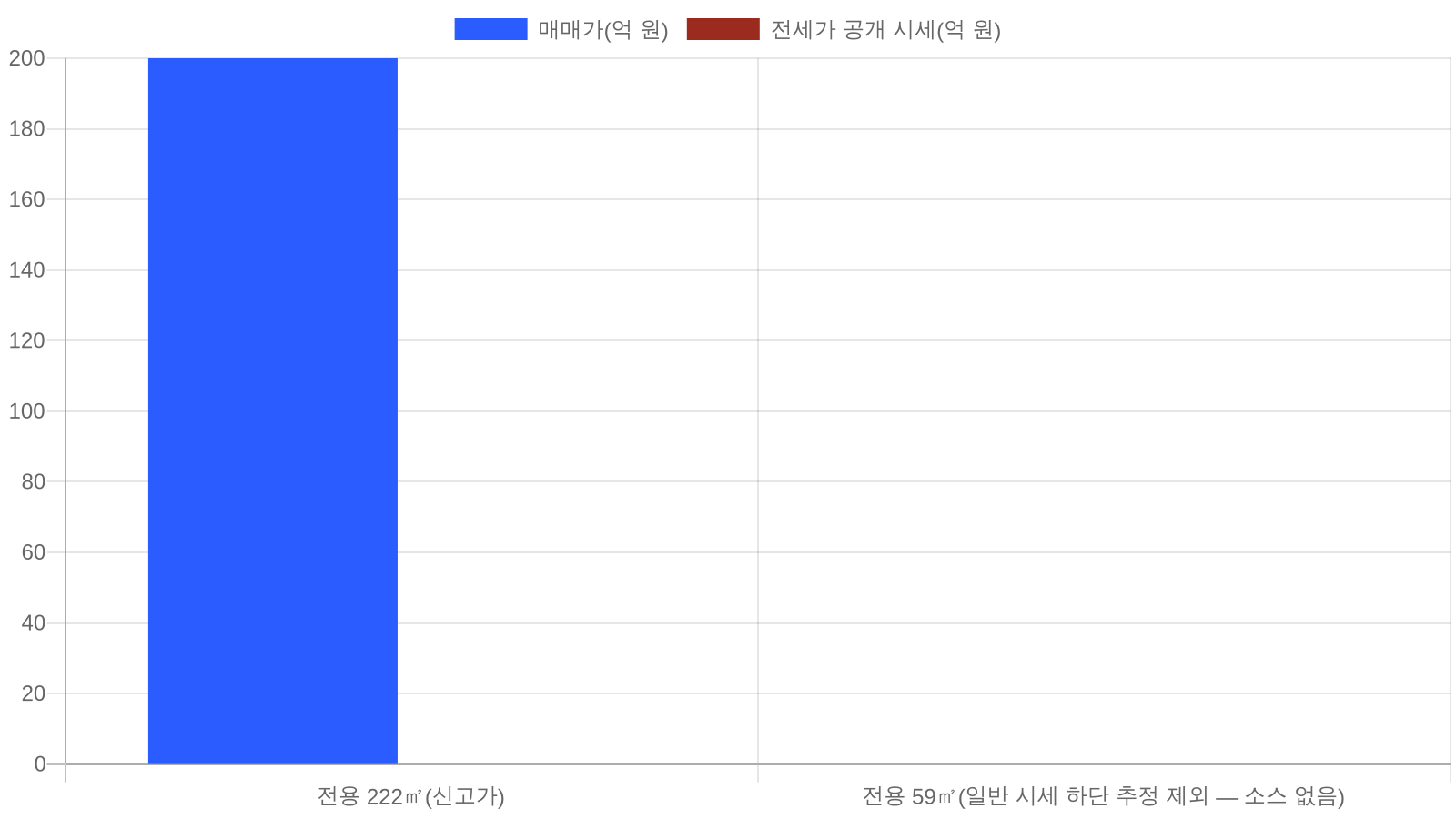
In the second half of 2025, prime Gangnam-area prices moved up another level. According to the Korea Economic Daily, a 222㎡ unit at Cheongdam Le El in Cheongdam-dong, Gangnam-gu, Seoul traded at KRW 20 billion, setting a new all-time high for the complex. The same article noted a broad upward trend in Cheongdam-dong apartment prices, citing Han River views and the prestigious Gangnam School District 8 (8-haggun) as the two key premium factors driving prices higher.
Viewing that KRW 20 billion sale price through the lens of the jeonse-to-price ratio (jeonse-gayul) reveals a different picture. High-end Korean apartments commonly see jeonse-gayul fall below 40%. Even if we assume a jeonse deposit of around KRW 8 billion for the 222㎡ unit, the gap (sale price minus jeonse deposit) still exceeds KRW 12 billion. The source article does not provide direct jeonse transaction figures, so this estimate cannot be treated as definitive. The direction, however, is clear: the higher the sale price and the lower or flat the jeonse-gayul, the more the gap expands in one direction only.
A widening gap is not simply "home prices got more expensive." It means the amount of cash that must be covered by one's own funds—whether by an investor using jeonse (cheonse) leverage or an end-user buying for personal occupancy—increases proportionally. This post uses the Cheongdam Le El record high as a starting point to explore, in numerical terms, how jeonse-gayul and the gap function as benchmarks in an end-buyer's decision-making.
How Does the Gap Structure Change When Jeonse-gayul Is Low?
Jeonse-gayul is the ratio of the jeonse deposit to the sale price. For example, if a KRW 1 billion apartment carries a KRW 700 million jeonse deposit, the jeonse-gayul is 70% and the gap is KRW 300 million. If the same unit's sale price rises to KRW 1.5 billion while the jeonse deposit stays at KRW 700 million, the jeonse-gayul drops to 47% and the gap widens to KRW 800 million. A falling jeonse-gayul is itself a synonym for an expanding gap.
Ultra-high-end Cheongdam-dong units attract an extremely limited pool of jeonse tenants. The universe of renters who can afford jeonse on a 222㎡ unit is narrow, making it difficult for jeonse prices to keep pace with rising sale prices. Sale prices move on scarcity premiums and asset-appreciation expectations; jeonse prices tend to converge toward actual "use value." The greater the divergence between the two, the less accessible a property becomes through jeonse leverage (gap investment, or gap-tuja).
A wider gap also contains another risk: when sale prices correct, they can fall by a larger magnitude than jeonse prices. Complexes with low jeonse-gayul see the absolute size of the gap shrink during a price decline, but there is a paradoxical "buffer effect" in that the zone where a landlord cannot return the tenant's deposit (the so-called jeonse trap) arrives later. Whichever way you interpret it, knowing the absolute size of the gap should be the first number in any buying or renting decision.

Supply Expansion Signals and Their Relationship to Jeonse-gayul
Meanwhile, the Seoul Metropolitan Government recently announced a large-scale housing supply plan. According to the Korea Economic Daily, Seoul set a target of supplying 310,000 housing units by 2031, pledging to deliver "results that citizens will feel." Redevelopment and reconstruction projects near Yongsan Station and along the Han River are also picking up speed. Once supply actually enters the market, some cushioning effect appears in the jeonse market. More jeonse listings reduce upward pressure on jeonse prices, which in turn can act as a brake on further jeonse-gayul declines.
That said, there is a significant lag between supply plans and actual move-ins. A 2031 target requires at least five or more years of construction from now, during which the existing stock dominates the market. In areas like Cheongdam-dong where redevelopment issues are entangled, existing tenants must relocate, paradoxically tightening short-term jeonse supply. This is why a supply expansion announcement does not immediately narrow the gap.
Nationwide, the week with the highest projected presale (bunyang) volume this month is approaching. According to Yonhap News, 8,905 housing units will go on presale across the country next week. The expected gap for each presale complex—that is, the difference between the presale price and the surrounding jeonse market price—is also a number end-buyers should verify in advance. Even if the presale price is high, a similarly high local jeonse price can keep the jeonse-gayul relatively healthy; conversely, if the presale price far exceeds local jeonse levels, the gap could become excessive by move-in time.
How to Read a Complex via Jeonse-gayul: Checkpoints
Jeonse-gayul is a single number, but the context embedded in it is multi-layered. The same 60% reading means completely different things depending on whether sale prices are rising or jeonse prices are falling. In periods like the current Cheongdam Le El record-high cycle, jeonse-gayul is structurally suppressed. Conversely, when supply increases or during economic downturns, jeonse prices may decline first, causing jeonse-gayul to fall even faster.
From an end-buyer's perspective, the absolute gap amount is "the floor of the equity you must mobilize." If you are buying with pure equity and no jeonse leverage, the gap concept does not apply directly—but if you are buying with a sitting jeonse tenant (gap investment) or renting while waiting for a purchase opportunity, the gap size becomes a very real barrier to entry. In top-tier Cheongdam-dong complexes where the gap can easily exceed tens of billions of won, a jeonse leverage strategy is essentially non-viable.
A large gap is not automatically dangerous, and a small gap is not automatically safe. Complexes with a narrow gap have high jeonse-gayul, which raises the risk that a landlord cannot return the tenant's deposit (so-called kkangthong jeonse, or "empty-can jeonse"). Ultimately what end-buyers need is not just a jeonse-gayul number in isolation, but the ability to read simultaneously the direction and speed of both sale prices and jeonse prices.
Things to Verify
- Check the past 6 to 12 months of actual sale and jeonse transaction prices for the complex of interest directly in the Ministry of Land, Infrastructure and Transport's Real Transaction Price Disclosure System.
- Calculate jeonse-gayul yourself: (most recent jeonse transaction price ÷ most recent sale transaction price) × 100.
- Confirm whether the absolute gap amount falls within the equity you can actually mobilize.
- Determine whether sale prices or jeonse prices are trending up—and which is moving faster.
- Check whether redevelopment or reconstruction relocation demand is likely to arise in or near the complex in the near term (relocation demand → potential short-term jeonse price increase).
- Confirm whether the supply plan (e.g., Seoul's 310,000-unit target) overlaps with the move-in timing for the area of interest — large move-in volumes can generate downward pressure on jeonse prices.
- If considering a cheongyak (housing subscription / presale lottery), compare the presale price against jeonse prices for similar units nearby to pre-calculate the expected gap at move-in.
References
- Han River views and School District 8 — Apartments rewriting Cheongdam-dong prices (Korea Economic Daily)
- "310,000 units by 2031 — results citizens will feel" (Korea Economic Daily)
- Yongsan Station + Han River riverside: redevelopment and reconstruction accelerating (Korea Economic Daily)
- [Real Estate Calendar] 8,905 units nationwide on presale next week — most this month (Yonhap News)