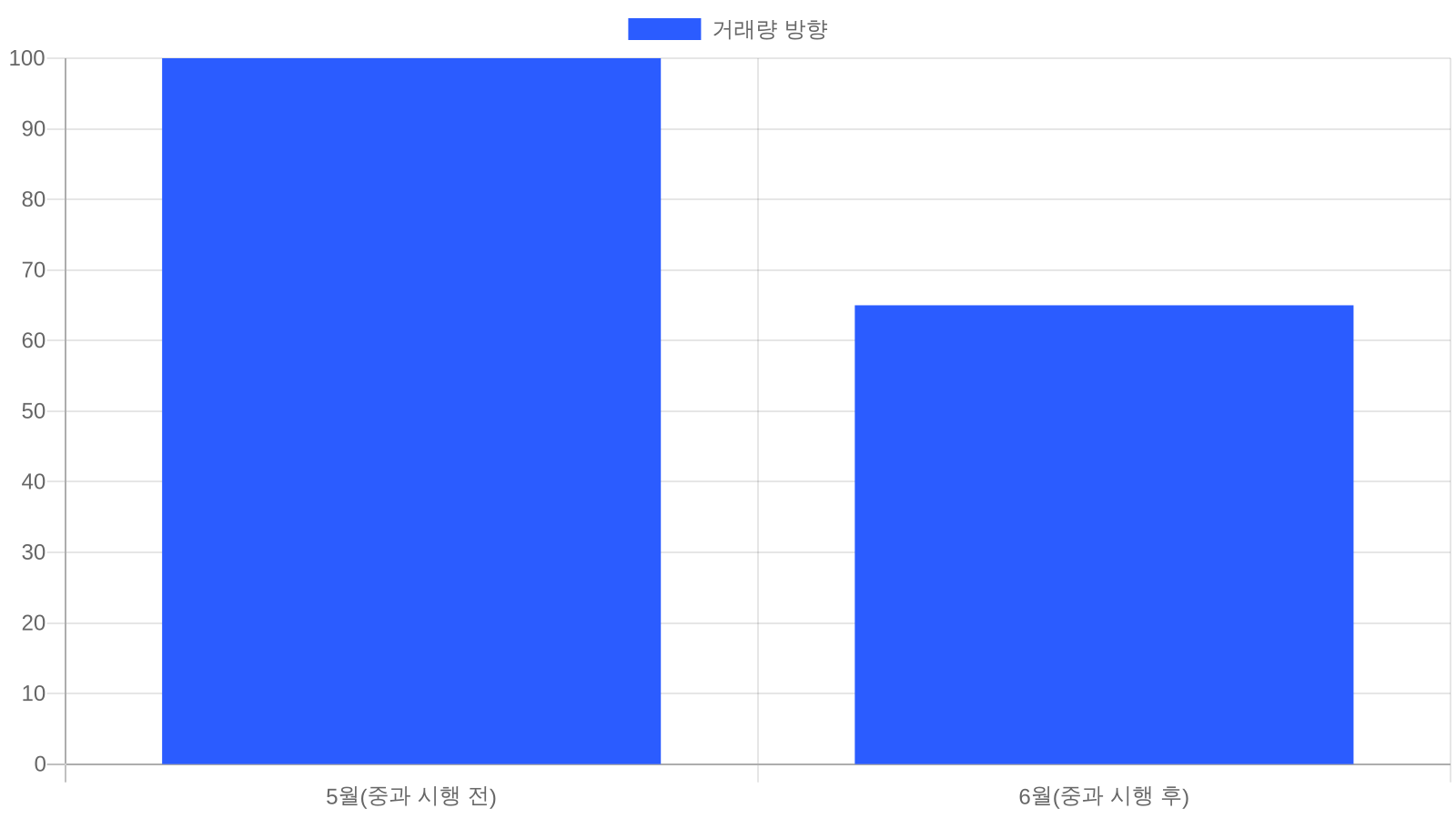
After the capital gains tax (yangdo-se jungkwa) surcharge took effect on May 10, June apartment transactions in Seoul dropped sharply compared to the previous month. Yonhap News summarized the trend as "widespread wait-and-see sentiment causing a sharp drop in transactions." A transaction freeze is not a new phenomenon, but the simultaneous news of accelerating redevelopment in Yongsan and along the Han River, together with a prosecutor's declaration of a crackdown on speculation, is creating a situation where each district's temperature reading diverges noticeably.
Transaction Volume Decline: What the Numbers Say
The capital gains tax surcharge directly raises the cost of selling for multi-home owners. When the tax burden rises, the market produces two reactions: hold and pull listings, or absorb the tax and sell. The fact that June transactions fell sharply month-on-month shows that the majority of market participants chose the former.
When the will to sell weakens, listings shrink, and for end-buyers the number of available options narrows. A phase in which transactions stop—neither prices clearly rising nor clearly falling—is what the phrase "wait-and-see sentiment spreading" actually describes. This stagnation is likely to continue until the direction of tax reform is confirmed.
One important caveat: a drop in transaction volume does not automatically mean price declines. When asking prices remain unchanged while transactions dry up, actual transaction data does not accumulate fast enough to determine the price direction with certainty. To read the temperature of Seoul's apartment market right now, you need to look at individual district and complex-level listing supply changes alongside the overall transaction volume indicator.
Yongsan and the Han River: A Separate Circuit Driven by Development Expectations
Even while transactions decline broadly, certain zones move on a different circuit. The Korea Economic Daily reported that redevelopment and reconstruction projects near Yongsan Station and along the Han River are gaining momentum. As development catalysts become more concrete, listings in those zones actually become locked away. The stronger owners' conviction that "selling now means a loss," the fewer the transactions and the more resilient—or rising—the asking prices.
In these zones, the pressure from the capital gains tax surcharge operates differently. If the expected development gains are large enough to offset the tax burden, owners choose to hold; if development uncertainty is high, they rush to sell before the surcharge kicks in. A concentration of transactions in Yongsan and Han River areas before May would itself be a reflection of that psychology.
The Seoul Metropolitan Government has presented a plan to supply 310,000 housing units by 2031. According to the Korea Economic Daily, the target is to deliver "results citizens will feel." Once large-scale supply plans begin to show real progress, the temperature gap between fast-moving and slow-moving redevelopment projects within the same zone could widen further.
Prosecutorial Crackdown on Speculation: An Additional Variable for Market Psychology
Prosecutors declared a crackdown on real estate speculation and price manipulation, designating dedicated prosecutors nationwide. Yonhap News reported this as part of the Lee Jae-myung administration's "all-out" stance on price stabilization. Tax pressure (capital gains surcharge) and legal risk (prosecutorial investigation) are now operating simultaneously.
The combined effect on the market is not straightforward. For multi-home owners, legal risk is a factor that accelerates selling—but at the same time it raises wariness about every traceable transaction. While transparent actual-price reporting is the rule, a heavier prosecutorial investigation atmosphere can also cultivate a psychology of deferring transactions altogether. The net effect is likely to add further downward pressure on transaction volume in the short term.
One more court ruling deserves attention. A court ruled that the cancellation of an apartment sale contract was justified because the seller concealed severe noise from an underground mechanical room. According to Yonhap News, the pivotal issue was that the seller knew about the noise defect and withheld it from the buyer. In an environment where the legal climate is tightening, the duty to disclose defects becomes a sensitive issue for both parties to a transaction.
With the capital gains surcharge and prosecutorial investigations both active at the same time, the temperature of Seoul's apartment market is divided not by the overall average but by each district and complex's development pace and degree of listing lockup.
Reading Inter-District Temperature Differences: A Framework
Reading the entire Seoul market at the same temperature based on a single aggregate drop in transaction volume is not accurate. The table below organizes the key variables that differentiate the current market. Mapping an individual district or complex onto this framework helps identify which phase it is currently in.
| Variable | Active Transaction Zone Characteristics | Stagnant Transaction Zone Characteristics |
|---|---|---|
| Development catalyst | Redevelopment/reconstruction progress becoming visible | Development plan unclear or long-delayed |
| Listing trend | Listings locked — asking price floor is firm | Listings increasing — room for negotiation |
| Tax impact | Development gain expectation offsets tax burden | Tax burden compresses effective return |
| Demand profile | Long-term holders expecting development benefit | Mobility-driven demand — high price sensitivity |
The critical variable in the table is "visibility of development pace." The reason Yongsan and the Han River riverside attract attention is not simply their prime location, but because project progress has started to be confirmed in numbers. Conversely, complexes with development expectations but opaque project timelines simultaneously show locked-up listings and no transactions — creating a state where "the price is unknowable."
Things to Verify
- Directly compare May and June transaction counts for the complex of interest in the Ministry of Land's real transaction price disclosure system — also compare to the same period in the prior year.
- Confirm whether the zone is at the project implementation approval stage or the association establishment stage of redevelopment/reconstruction — the expected project completion date differs by years depending on the stage.
- Track whether the number of listings for the same complex and unit size on real estate platforms has increased or decreased over the past month — changes in listing supply are a faster leading indicator than official transaction statistics.
- Check the schedule for capital gains tax reform discussions (exemption or rate adjustment) — transaction volume is likely to respond at the point when the reform direction is confirmed.
- Review the history of defect disclosure for mechanical room or elevator noise — under recent court precedent, violation of disclosure obligations is grounds for contract cancellation.
- Monitor reporting on prosecutorial speculation investigations to see whether the district or complex in question is mentioned — complexes near areas under investigation are directly affected by short-term transaction psychology.
References
- Seoul apartment market ahead of tax reform: "wait-and-see spreads, transactions fall sharply" — Yonhap News
- Yongsan Station + Han River: redevelopment and reconstruction accelerating — Korea Economic Daily
- "310,000 units by 2031 — results citizens will feel" — Korea Economic Daily
- Prosecutors join war on real estate speculation — dedicated prosecutors assigned nationwide — Yonhap News
- Apartment sale with concealed mechanical room noise — court rules contract cancellation justified — Yonhap News