
Good school districts mean higher home prices — a proposition long accepted as self-evident. Yet the moment you try to narrow this relationship down to numbers, you run into the question: "How much is the school district effect, and how much is transit access, reconstruction expectations, or policy variables?" Especially in a market like the current one — where transactions have declined after the capital gains tax (yangdo-se jungkwa) surcharge — the school district premium signal is easily buried in noise.
The Current Seoul Market Temperature: Transaction Decline and Wait-and-See
Before discussing the school district premium, one must first read the current market state. According to Yonhap News, after the capital gains surcharge took effect on May 10, Seoul apartment transactions in June fell sharply from the previous month and wait-and-see sentiment is deepening. A decline in transaction volume also means price signals are becoming blurrier. A new record high could be from a single transaction; a figure that looks like a decline could be just one distressed sale.
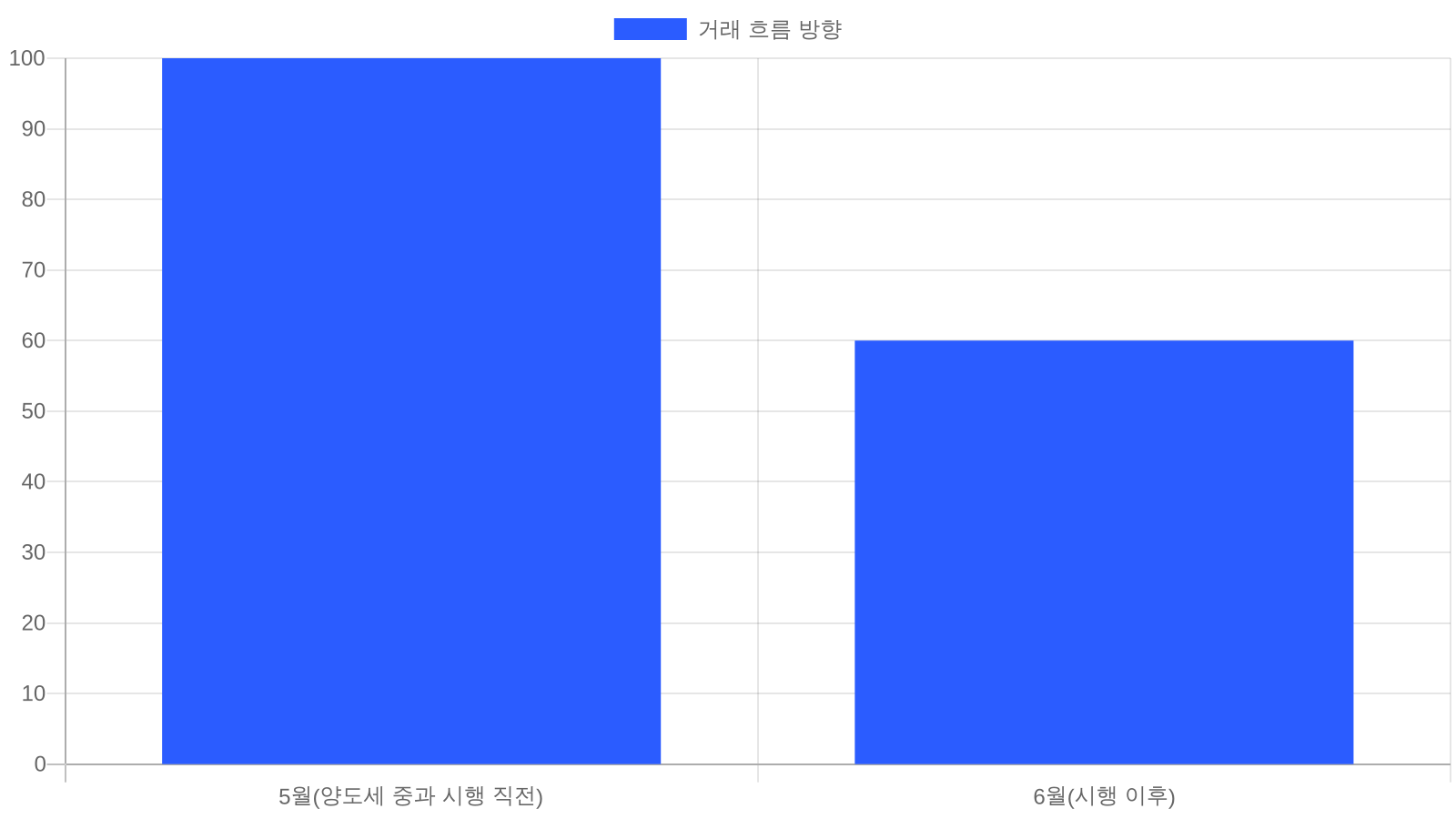
This context creates a caution when discussing the school district premium. Ahead of tax reform, sellers pull listings due to the tax burden while buyers defer decisions while waiting for further changes. In periods when no transactions are completed, it is hard to prove with actual transaction data either that "school district complexes held firm" or that "the school district premium has deflated." Where there are no numbers, only narratives grow.
Therefore, when looking at school district area prices during a wait-and-see market like this, rather than single-transaction record highs or record lows, you should look at cumulative transaction counts and the bid-ask spread (difference between seller and buyer asking prices) together. If asking prices are high with no actual transactions, that is not a market price — it is a wishful price.
School District Premium — The Range Data Can Confirm
Starting with what can be confirmed relatively well with public data: in the Ministry of Land's real transaction price disclosure system, separating complexes of similar age and unit size by school zone boundaries within the same district reveals a pattern of price-per-3.3㎡ differences depending on school zone — a pattern that appears repeatedly in multiple studies and press reports. This supports the point that "school district is a variable" up to that conclusion.
However, how large the difference is and whether it stems solely from the school district are separate questions. Take what is called the "8-haggun" (school district 8) of Gangnam and Seocho — along with the school district, this area simultaneously has business district accessibility, reconstruction expectations, concentration of branded complexes, and high-income demand as price-lifting variables. Without isolating the variables, concluding "the school district drove prices up" becomes overinterpretation.
This complexity is evident just looking at Seoul's major development plans. According to the Korea Economic Daily, redevelopment and reconstruction near Yongsan Station and along the Han River are gaining speed. When certain Yongsan-area complexes come up in discussion, it is nearly impossible to separate whether a price increase is due to the school district effect or development expectations. A premium is the product of multiple overlapping factors.
A school district is one factor in home prices — not the single variable that explains the price. Not knowing the difference means you are buying and selling a narrative, not data.
Things Data Makes It Difficult to Confirm
The weakest point in the school district premium discussion is "future school districts." In new towns or large new construction developments, there are cases where the expectation that "a prestigious school will be assigned" or "school district demand will concentrate" is front-loaded into the price. However, the academic level of a newly established school and whether school zone boundaries will be maintained cannot be verified at the time of presale.
Also, how much the structural demographic shift of declining school-age population will dilute the school district premium is difficult to determine definitively with current data. With the Seoul Metropolitan Government targeting 310,000 units by 2031 per the Korea Economic Daily, if supply increases while the school-age population declines, the scarcity logic of certain school districts may be undermined. Whether "today's well-known school district" maintains the same level of demand ten years from now is inference, not fact.
There is also the variable of intensified speculation enforcement. With prosecutors designating dedicated prosecutors nationwide and launching strict action on speculation and price manipulation (Yonhap News), the approach of "school district gap investment (gap-tuja)" for short-term profit becomes more cumbersome in terms of the transaction itself. At what level the school district premium converges once investment demand withdraws will only be visible over time.
A Decision Framework for End-Buyers
| Verification Item | Verification Method | Caution |
|---|---|---|
| Actual transaction price trend | Ministry of Land real transaction price system, past 6 months count and price distribution | If fewer than 5 transactions, unit price reliability is low |
| School zone boundaries | School Info (hakgyo-allimi) / education office assignment zone notice | Boundaries can change annually — must re-confirm before enrollment |
| Comparable complex comparison | Compare asking prices of similar-age, same-size complexes in nearby non-school-zone areas | Development catalyst must be removed first to isolate school district effect only |
| Tax burden simulation | Confirm capital gains surcharge applicability, holding period, multi-home owner status | High tax burden → listing lockup → asking price may not reflect actual market |
| Supply plan | Seoul's Jeongbi Mongttang, confirm project implementation approval stage | Large-scale nearby supply planned → scarcity logic may weaken |
Things to Verify
- Have you confirmed that the actual transaction count in the Ministry of Land's real transaction price data for the complex of interest is sufficient over the past six months?
- Have you confirmed the school zone boundary for the complex using the most recent education office notice — exactly which line it falls on?
- If there are price differences between complexes within the same school zone, have you tried to isolate which variables beyond school district (reconstruction age, proximity to station, brand) are responsible?
- After the capital gains surcharge took effect (May 10, 2025), if transactions in the area have declined, have you assessed whether the current asking price reflects actual selling intent?
- Have you confirmed whether there are supply plan complexes nearby (including Seoul's reconstruction/redevelopment) and when they are scheduled to move in?
- Are you evaluating the school district premium with a clear premise — whether your purchase purpose is actual occupancy (child enrollment) or capital appreciation — since the meaning of the premium differs depending on the answer?
References
- Seoul apartment market ahead of tax reform: "wait-and-see spreads, transactions fall sharply" — Yonhap News
- Yongsan Station + Han River: redevelopment and reconstruction accelerating — Korea Economic Daily
- "310,000 units by 2031 — results citizens will feel" — Korea Economic Daily
- Prosecutors join war on real estate speculation — dedicated prosecutors nationwide — Yonhap News