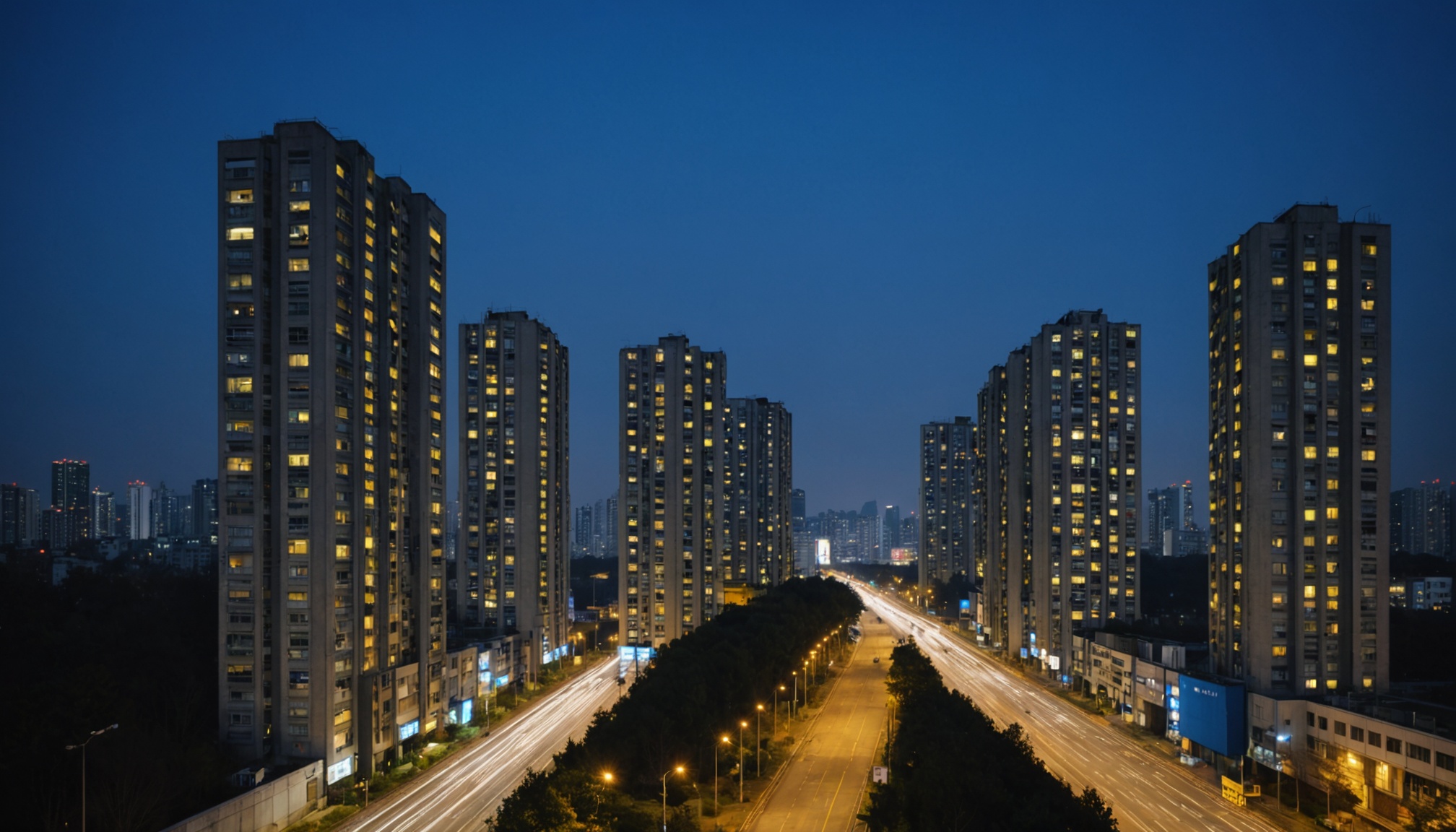
The income ceiling for jeonse (lump-sum deposit lease) public housing in Seoul splits at an exclusive floor area of 85 square metres. Units at or below 85 square metres require household income at or under 105% of the urban worker household average; above that size the cap rises to 150%. Translated into won for a four-person household, that is 9,242,312 and 13,203,303 a month. Dual-income households are allowed up to 140% or 200%.
Seoul Housing and Communities Corporation (SH) opened applications for its 51st round of long-term jeonse housing on August 31. The total is 1,381 units: 291 across nine newly supplied complexes and 1,090 re-offered across 70 existing ones. Applicants must be adult members of a non-homeowning household resident in Seoul as of the announcement date, with the income cap set at either 105% or 150% depending on unit size, Etoday reported.
What 105% actually means for your household
A percentage alone decides nothing. The reference figures come from the 2026 monthly average income table for urban worker households by household size published by SH. Reading the 105% and 150% columns directly and multiplying by 12 for an annual figure gives the following. The annual conversion is included because most people gauge their position from an annual withholding statement.
| Household size | 105% monthly cap (won) | Annual (won) | 150% monthly cap (won) | Annual (won) |
|---|---|---|---|---|
| 1 | 4,004,031 | 48.04m | 5,720,045 | 68.64m |
| 2 | 6,159,584 | 73.91m | 8,799,405 | 105.59m |
| 3 | 8,576,850 | 102.92m | 12,252,644 | 147.03m |
| 4 | 9,242,312 | 110.91m | 13,203,303 | 158.44m |
| 5 | 9,793,334 | 117.52m | 13,990,478 | 167.89m |
The striking gap sits between two and three people. At 105% a two-person household is capped at 6.16m won and a three-person household at 8.58m — one additional member lifts the ceiling by 2.42m won. Moving from four to five adds only 550,000 won. Because the brackets are unevenly spaced, a first or second child loosens the income requirement far more than a third.
Reverse out the baseline once and it works on every other public housing announcement. Since 105% for four people is 9,242,312 won, the 100% figure is 8,802,202 won. Multiply that by 1.5 and it lands exactly on the 13,203,303 won in the 150% column. Announcements cite 70%, 90% or 120% depending on the programme, and a single baseline figure converts all of them.
The 85-square-metre threshold deserves a second look. A unit with 84 square metres of exclusive area falls in the lower band and takes the 105% cap. Confusing exclusive area with supply area — and reading a 34-pyeong unit as exceeding 85 square metres — puts the wrong percentage in play. The relationship between the two is set out in the piece on why 84 square metres is called 34 pyeong.
How far a child raises the ceiling
In this round, income and asset caps are relaxed by up to 20 percentage points according to the number of children born. The relief is 10 points for one child and 20 points for two or more. Guidance on the Ministry of Land's MyHome portal specifies that the addition applies to minor children (including unborn) born on or after March 28, 2023, and that the total asset ceiling also steps up from 662m won to 728m and then 794m won.
Calculated for a four-person household applying at or below 85 square metres, the combinations spread out as follows.
| Case | Applied rate | Monthly income cap (won) | Total asset ceiling |
|---|---|---|---|
| Base (single earner) | 105% | 9,242,312 | 662m won |
| One child | 115% | 10,122,532 | 728m won |
| Two or more children | 125% | 11,002,753 | 794m won |
| Dual income | 140% | 12,323,083 | 662m won |
| Dual income + one child | 150% | 13,203,303 | 728m won |
| Dual income + two or more | 160% | 14,083,523 | 794m won |
Measured in won, moving from 105% to 125% raises the monthly ceiling by 1,760,441 won, or 21.12m won a year. The increase from 140% to 160% is the same 1.76m won. Twenty percentage points is 20% of the four-person baseline of 8,802,202 won wherever it is applied.
A four-person household applying above 85 square metres starts at 150%, reaching 160% with one child and 170% with two or more, while dual-income households go up to 200%. The 170% cell works out at 14,963,743 won a month. Given that many of the newly supplied complexes sit in Gangnam and Seocho, the numbers show why ceilings in this band have drawn criticism.
The percentages change with every announcement, but one figure — 8,802,202 won for four people at 100% — turns any of them, 105% or 170%, into a single multiplication.
Lease terms and the application calendar
Long-term jeonse housing is public rental with no conversion to ownership. According to Seoul Housing Portal guidance, deposits are set at 80% or less of surrounding market levels, contracts renew in two-year cycles up to a maximum of 20 years, and renewal increases are capped at 5%. Because there is no monthly rent, the practical barrier to entry is whether the full deposit can be financed.
Applications are staggered by priority tier: first tier on September 14-15, second on September 16, and third and fourth on September 17, online and in person, Herald Business reported. The new complexes include Raemian Leventus in Gangnam (24 units), Doosan We've the Prestige in Guro (49), DH Bangbae in Seocho (133), Autier Banpo in Seocho (20), Yeongdeungpo Xi (36), Seongdong Xi Riverview (9), Imun 3 in Dongdaemun (2), Urbanheim in Jungnang (1), and Cheongdam Le-El in Gangnam.
One complex, DH Bangbae, accounts for 133 of the 291 new units — 45.7% of the total. The remaining eight add up to 158 units, three of them offering nine or fewer. With volume distributed that unevenly, applicant demand concentrates on a handful of complexes. The 1,090 re-offered units are also spread thin across 70 complexes, averaging 15.6 units each.
A housing subscription savings account remains usable for sale-type applications even after moving in. How quickly the cumulative savings total builds is covered in the piece on the 250,000-won monthly recognition limit.
What to check
- Exclusive floor area of the target unit — at or below 85 square metres takes 105%, above takes 150%. It is exclusive area, not supply area.
- Household size counting — which row of the table applies sets the ceiling. Verify the definition of household member against the announcement, not assumptions.
- Child's date of birth — whether the birth falls on or after March 28, 2023 decides the 10- or 20-point addition. Children born earlier do not qualify.
- How dual-income status is judged — the 140% and 200% caps come with separate conditions on earning household members. Match the announcement's wording exactly.
- Total assets and vehicle value — the 662m won asset and 45.42m won vehicle ceilings apply independently of income, with valuation rules set by the announcement.
- Deposit financing plan — even at 80% of market level, Gangnam and Seocho complexes carry large absolute deposits. Calculate loan capacity and own funds before ranking preferences.
- Your tier's application date — September 14-15, 16, and 17 by tier. Missing the assigned date means waiting for the next round.
References
- SH opens applications for 1,381 long-term jeonse units, 51st round (Etoday)
- SH supplies 1,381 long-term jeonse units including DH Bangbae and Cheongdam Le-El (Herald Business)
- 2026 monthly average income by urban worker household size (SH)
- Long-term jeonse housing guide (MyHome portal, Ministry of Land)