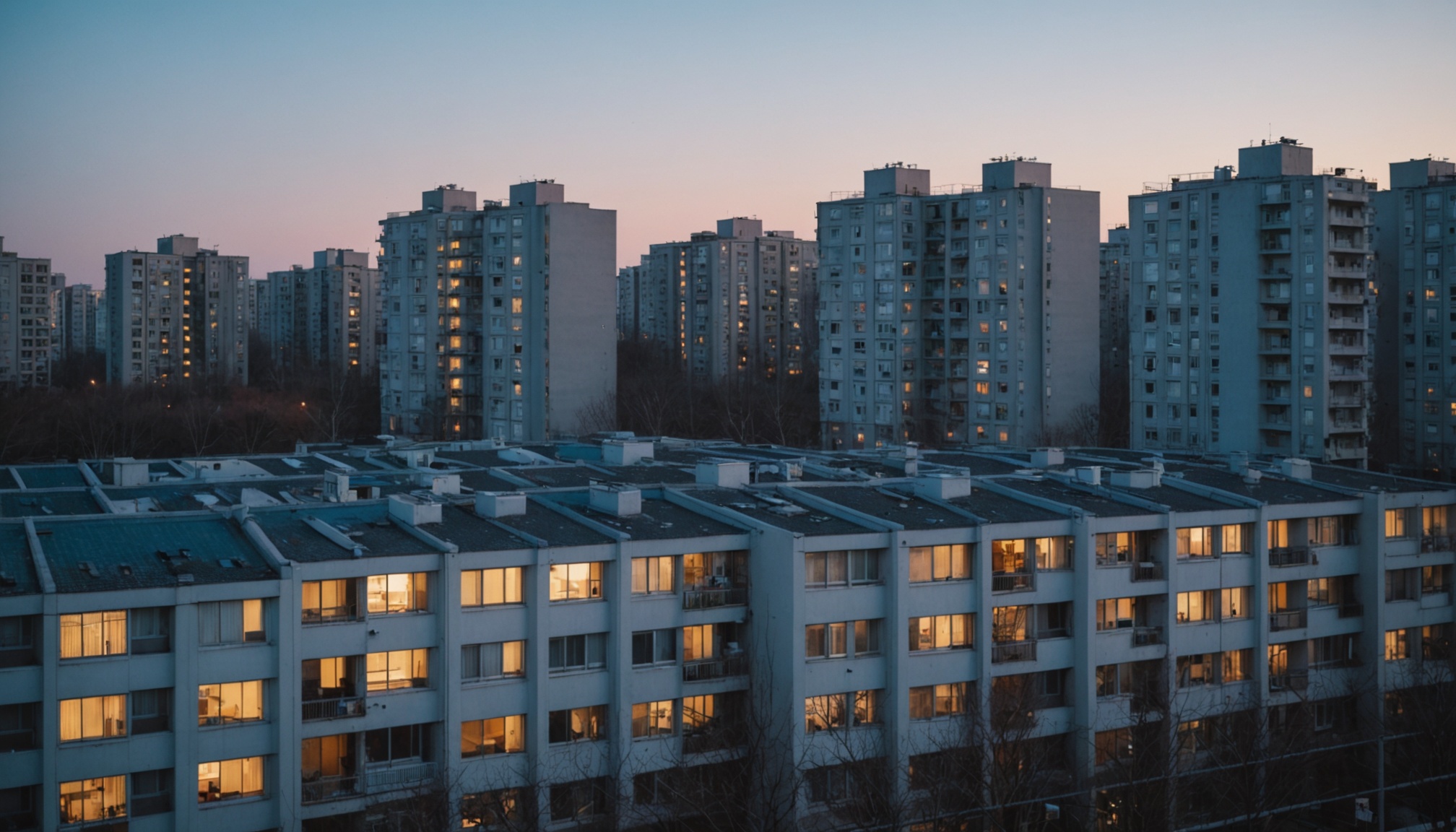
The long-term repair reserve — jangki suseon chungdanggeum — that leaves a tenant's account every month inside the apartment maintenance bill is money the landlord owes back at move-out. Article 30 of the Multi-Family Housing Management Act requires this fund to be collected from the owner of the unit. Even where the building's management bylaws have the tenant pay it alongside other charges, the tenant can claim reimbursement from the owner once the lease ends.
The amount varies by complex, but it is calculable, because the enforcement decree fixes the formula. Running real numbers through it below puts a unit of 110 square metres of supply area somewhere between 16,000 and 49,000 won a month — 390,000 to 1,180,000 won over a two-year lease.

How Much Comes Back: The Statutory Formula With Real Numbers
The monthly per-household reserve is not a figure the management office invents. The formula in the enforcement decree, as summarised by Korea's Easy Law service, reads as follows.
Monthly household reserve = [total repair cost over the plan period ÷ (total supply area × 12 × plan period in years)] × household supply area
There are effectively two variables: the total repair budget in the complex's long-term maintenance plan, and your own supply area. Assume a complex with 112,200 square metres of total supply area (1,020 units of about 110 sq m) and a ten-year plan period, then vary only the repair budget.
| 10-year repair budget | Monthly rate (KRW/sq m) | 110 sq m unit, monthly (KRW) | 79 sq m unit, monthly (KRW) |
|---|---|---|---|
| 2.0bn won | 148.5 | 16,340 | 11,740 |
| 3.0bn won | 222.8 | 24,510 | 17,600 |
| 4.0bn won | 297.1 | 32,680 | 23,470 |
| 6.0bn won | 445.6 | 49,020 | 35,210 |
The denominator is 112,200 × 12 × 10 = 13,464,000, so dividing the repair budget by that figure gives the monthly rate per square metre directly. A 4 billion won budget yields 297.1 won; multiplied by 110 square metres, 32,680 won. Stretch the plan period to twenty years and the same budget halves the monthly charge.
Multiply that monthly charge by the number of months lived there, and you have the sum claimable at move-out.
| Monthly charge (KRW) | Two years, 24 months (KRW) | Four years, 48 months (KRW) |
|---|---|---|
| 16,340 | 392,160 | 784,320 |
| 24,510 | 588,240 | 1,176,480 |
| 32,680 | 784,320 | 1,568,640 |
| 49,020 | 1,176,480 | 2,352,960 |
Older complexes, and those with more shared infrastructure such as lifts and underground parking, carry larger repair budgets. Those sit near the bottom rows, where a tenant who used the renewal right and stayed four years could arithmetically be owed more than two million won. A line item of 20,000 or 30,000 won a month becomes a meaningful lump sum.
The repair reserve is not the tenant's money — it is money the tenant paid on the owner's behalf. It merely travels inside the maintenance bill; its character was the owner's from the start.
You Claim From the Owner, Not the Management Office
This is where claims usually go wrong. The management office collected the money, but the obligation to return it sits with the landlord. Easy Law states plainly that reserves paid by a tenant during occupancy may be reclaimed from the owner of the housing unit when the lease terminates. The management office has no legal basis to hand it back.
Where the unit changed hands mid-tenancy, matters get one layer harder. The common reading is that the obligation follows the current owner, but practice depends on whether seller and buyer settled it at closing. Splitting the period at the balance-payment date, one share to the former owner and one to the current one, removes most of the room for dispute. A Supreme Court public-guidance case dealing with a management office demanding extra payment from a tenant likewise takes owner liability as its starting premise.
That principle follows from the nature of common areas. Replacing a lift, waterproofing a roof, repainting an exterior wall, swapping out pipework — these are expenditures that accrue to whoever holds the asset, not to the occupant. When asked how to calculate the charge for owners in a building without a lift, the Ministry of Government Legislation replied that the monthly household charge must be set uniformly in proportion to household supply area, making it difficult to carve lift-related costs out through the management bylaws. The area-proportional allocation of common-area burdens is that firmly fixed.
One Payment Certificate Is the Whole Evidence
Only one document is really needed. The management body must issue a payment confirmation certificate without delay when an occupant requests one. Ask at the management office and you receive a month-by-month statement of what was charged and paid during your occupancy; the total on that certificate is the amount you claim.
Strictly, then, no arithmetic is required — but knowing the formula lets you sanity-check the certificate. If the monthly rate per square metre falls below 100 won or exceeds 600 won, the complex has an unusual plan period or repair budget, and the management bylaws are worth reading.

If You Only Realised After Moving Out
Leaving without settling this is common enough. The question then is how long the claim survives. The usual explanation applies the ten-year limitation period for ordinary claims under the Civil Act. How the claim is characterised and when the clock starts can both change the answer, so for anything long past it is safer to check the limitation question with a body such as the Korea Legal Aid Corporation before acting.
The standard route is to obtain the payment certificate from the management office and serve a demand on the former landlord by certified content mail. Settling it together with the deposit refund at lease termination is by far the cleanest path, which is why requesting the certificate before the final payment changes hands is the surest move in practice. If the deposit itself is not coming back on time, the right first step is understanding the requirements and effective date of a lease registration order.
What to Check
- Special terms in the lease — any clause about who bears the repair reserve. The law places it on the owner, but contract wording is where disputes begin
- The rate and plan period in the management bylaws — the monthly rate per square metre and the plan length tell you immediately which row of the table you are in
- The payment certificate — request it from the management office before moving out; the monthly breakdown and total are your evidence
- Whether the owner changed during your tenancy — check the transfer date on the property register and split the period accordingly
- Timing of settlement — handle it the same day as the deposit refund; once the money has moved, reaching the landlord gets hard
- History of common-area works — if the work overlaps the statutory defect-liability periods by trade, it may fall under defect repair rather than the reserve fund
Sources
- Easy Law — Claiming a refund of the long-term repair reserve
- Easy Law — Long-term maintenance plans and the repair reserve
- Supreme Court of Korea — Who bears the long-term repair reserve in apartment maintenance fees
- Ministry of Government Legislation — Calculating the monthly household reserve for buildings without a lift