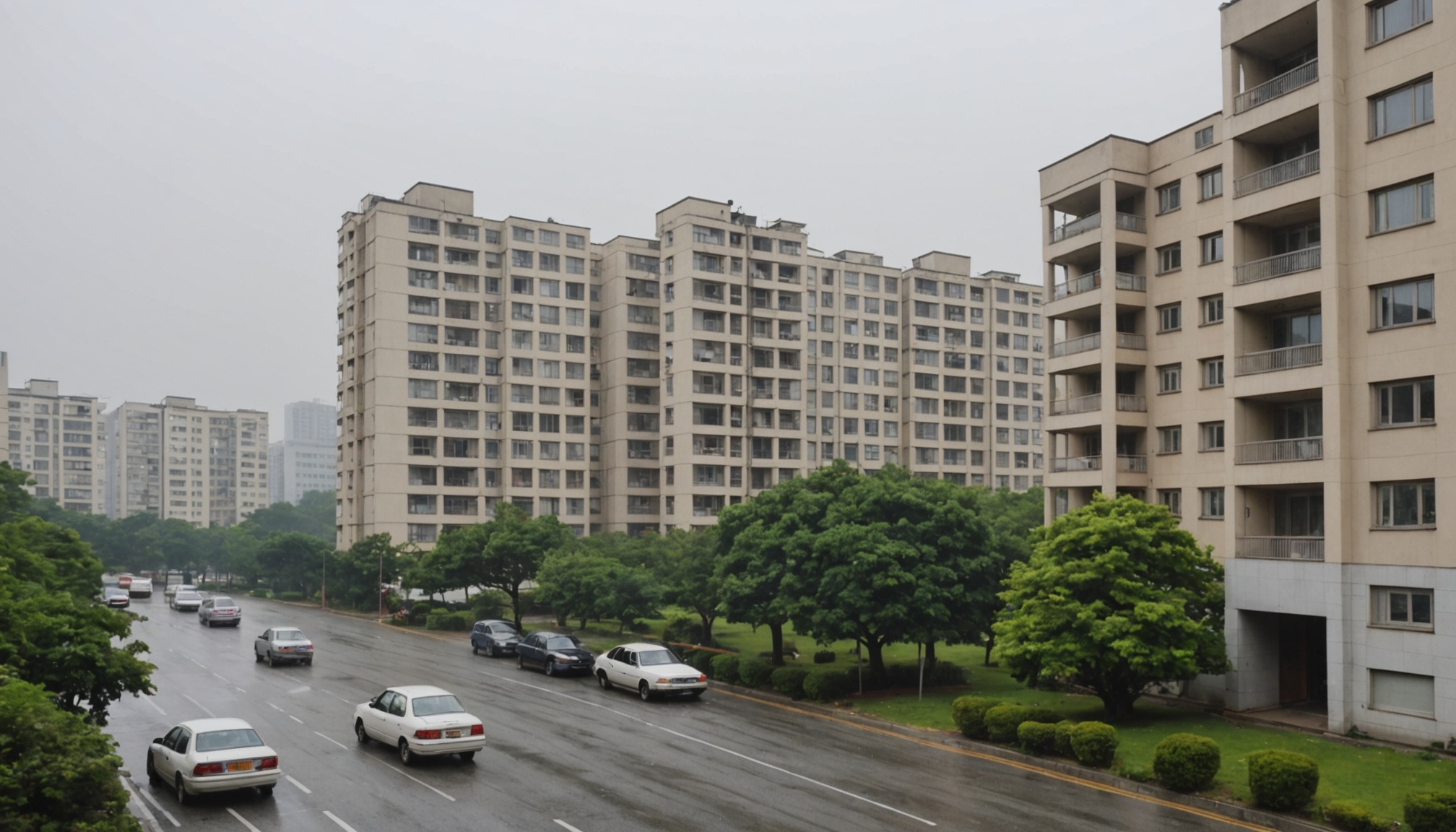
The second instalment of Korea's housing property tax (jaesanse) falls due between 16 and 30 September. It repeats the July amount. For a single-home household with an assessed value (gongsi price) of 500 million won, the annual bill is 620,000 won — and 310,000 won of it lands this month.
The same home without the single-home relief would owe 1,104,000 won a year. That gap of more than 484,000 won does not come from one line of the rate table but from two places at once: the fair market value ratio and the special rate. Working the bill backwards shows exactly where it splits.
What the September Bill Contains
Liability is fixed on whoever owns the property on 1 June each year. A buyer who settles on 2 June owes nothing for that year; the seller who held title on 1 June pays the whole thing. One day decides an entire year of tax.
Due dates split by asset type. Seocho District's guidance states that 16-31 July covers half of the housing tax plus the buildings portion, while 16-30 September covers the other half of the housing tax plus the land portion. Own only a home and the two bills match; own land as well and September is heavier.
Three items are summed on a single bill: the base property tax, an urban planning portion at 0.14% of the tax base, and a local education tax at 20% of the property tax. A regional resource facility tax is added separately. This is why calculating only the headline 0.1% rate leaves people surprised by the total.
Geumcheon District's guidance allows instalment payment over three months where the assessment exceeds 2.5 million won. That threshold applies to the assessment rather than to each due date, so it is worth confirming with the district tax office.
From Assessed Value to Tax Base: the 43-45% Step
The calculation runs in three steps. Assessed value times the fair market value ratio gives the tax base; the base times the rate gives the tax; the tax plus urban planning portion plus education tax gives the bill.
The first step splits on single-home status. As reported by Korea Tax Times, the 2026 fair market value ratio for a single-home household is 43% up to 300 million won of assessed value, 44% between 300 and 600 million, and 45% above 600 million. All other housing uses 60%.
The second step splits too. Standard rates are 0.1% up to a 60 million won base; 60,000 won plus 0.15% of the excess to 150 million; 195,000 won plus 0.25% of the excess to 300 million; and 570,000 won plus 0.4% above that. On top of this, a single home assessed at 900 million won or less receives a special rate that cuts each bracket by 0.05 percentage points, in force through 2026.
The single-home relief is not one line in the rate table — it works simultaneously on the ratio that builds the tax base and on the rate applied to it.
Written out, the special rates are 0.05% up to 60 million won; 30,000 won plus 0.1% of the excess to 150 million; 120,000 won plus 0.2% of the excess to 300 million; and 420,000 won plus 0.35% above that. The progressive structure is unchanged; only the bracket rates come down.

September Payments by Assessed Value
Those three steps, applied across assessed value bands for a single-home household. The regional resource facility tax is excluded because it varies with building valuation and local ordinance, and the urban planning portion assumes a property inside an urban planning zone.
| Assessed value | Ratio | Tax base (won) | Base tax (won) | Urban portion (won) | Education tax (won) | Annual total (won) | September (won) |
|---|---|---|---|---|---|---|---|
| 300m | 43% | 129,000,000 | 99,000 | 180,600 | 19,800 | 299,400 | 149,700 |
| 500m | 44% | 220,000,000 | 260,000 | 308,000 | 52,000 | 620,000 | 310,000 |
| 600m | 44% | 264,000,000 | 348,000 | 369,600 | 69,600 | 787,200 | 393,600 |
| 900m | 45% | 405,000,000 | 787,500 | 567,000 | 157,500 | 1,512,000 | 756,000 |
The 300 million won row stands out first. The base tax is 99,000 won while the urban planning portion is 180,600 won — 1.8 times larger. At 500 million the urban portion of 308,000 won again exceeds the 260,000 won base tax. The single-home special rate reduces only the base tax; the urban portion is a flat 0.14% of the tax base with no relief attached.
Crossing 300 million won also lifts the valuation ratio from 43% to 44%. Assessed value rises 66.7% between the 300 and 500 million rows, but the annual bill rises 107%. Progressive rates and a stepped ratio compound, so tax grows faster than value.
What the Relief Is Worth: 484,000 Won
Running the same 500 million won home under both conditions shows the size of it. On the left, a single-home household; on the right, an owner who does not qualify.
| Item | Single home (won) | No relief (won) | Difference (won) |
|---|---|---|---|
| Fair market value ratio | 44% | 60% | 16%p |
| Tax base | 220,000,000 | 300,000,000 | 80,000,000 |
| Base property tax | 260,000 | 570,000 | 310,000 |
| Urban planning portion | 308,000 | 420,000 | 112,000 |
| Local education tax | 52,000 | 114,000 | 62,000 |
| Annual total | 620,000 | 1,104,000 | 484,000 |
| September payment | 310,000 | 552,000 | 242,000 |
That is 484,000 won a year, or 43.8%. Of it, 310,000 won comes from the base tax; the remaining 174,000 won comes from the urban portion and education tax falling alongside the lower base. One ratio pulls three line items down together.
Note the difference in scope. The 43-45% ratio applies to any single-home household regardless of value, but the 0.05 percentage point rate cut is limited to homes assessed at 900 million won or less. A single home above that threshold gets the 45% ratio but pays standard rates. The full holding-tax picture only closes once you add the comprehensive real estate tax with its 1.2 billion won single-home deduction and 60% ratio.
What to Check
Items worth verifying when the bill arrives.
- Single-home status — check whether the ratio shown is 43-45% or 60%. Another home owned by any household member removes the relief
- Proximity to a band edge — 300 and 600 million won are where the ratio steps. Near an edge, contesting the assessed value during the objection window can pay off
- July and September amounts matching — if you own only a home and the two differ, check whether a land portion or resource facility tax has been folded in
- Whether the urban portion applies — homes outside an urban planning zone do not carry it. Since it can exceed the base tax, read the bill line by line
- Ownership on 1 June — if the property changed hands in the first half of the year, compare the settlement and registration dates, and check whether the contract included a tax apportionment clause
- Instalment application — available over three months where the assessment exceeds 2.5 million won, filed with the district tax office within the payment window
To see the first-year burden as a whole, read this alongside how acquisition tax lands between 1% and 3%.