The cheongyak point system is a straightforward 84-point addition structure. Yet every year, cases of disqualification after winning a ballot repeat themselves. The calculations are not inherently difficult — the problem is that a few reference points are set incorrectly. Now that the government has announced a plan to supply 310,000 units by 2031 via the Korea Economic Daily, presale volumes will increase. The more opportunities there are, the sooner prepared end-buyers will capture them.
The Point Structure First: Verify the Allocation for Each of the Three Categories
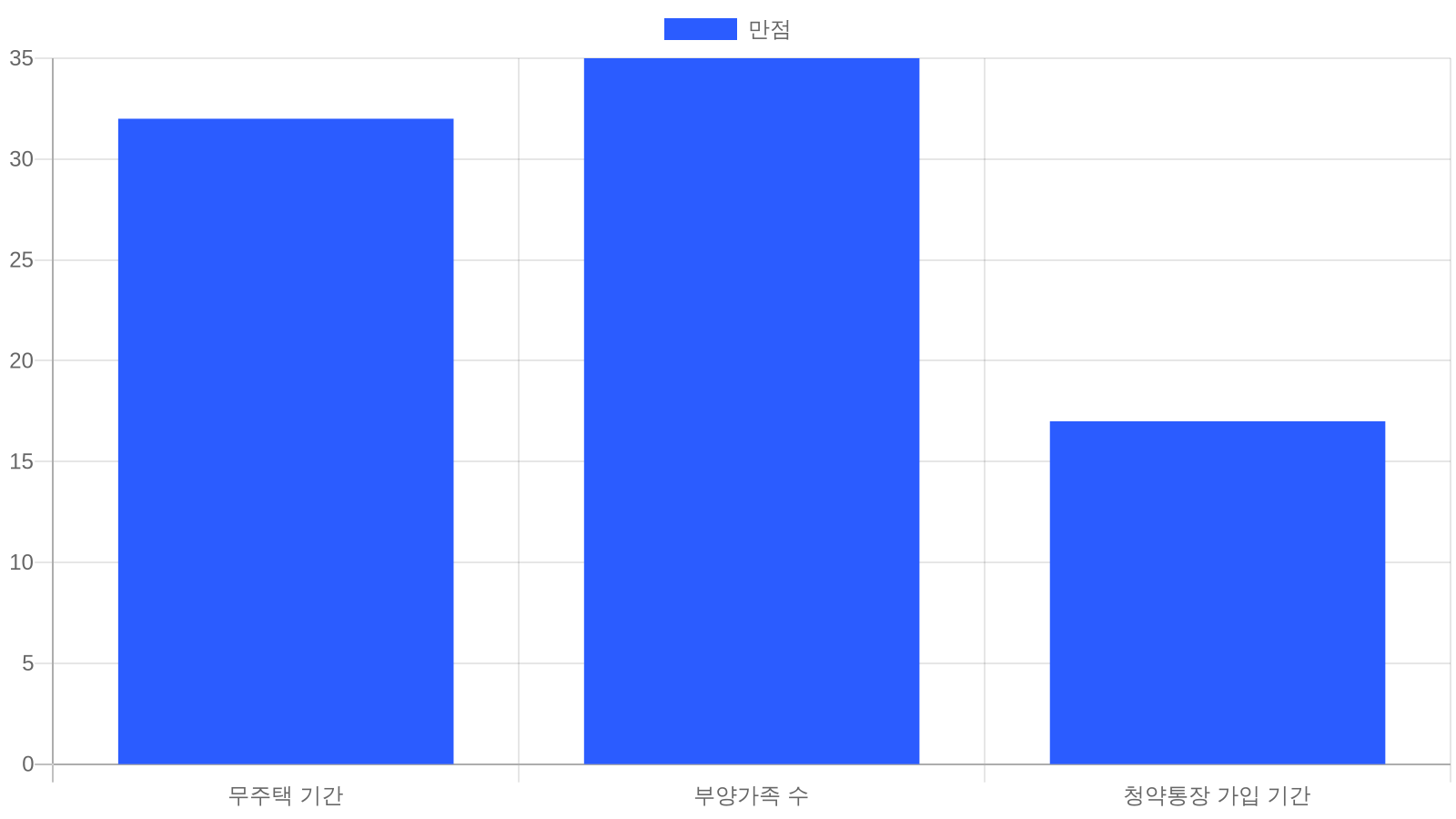
Cheongyak points are divided into three main categories: homelessness period (up to 32 points), number of dependents (up to 35 points), and subscription account tenure (up to 17 points). The maximum combined score is 84 points. Summarized in a table:
| Category | Maximum Points | Unit Basis |
|---|---|---|
| Number of dependents | 35 points | 6 or more = 35 pts / 0 dependents = 5 pts |
| Homelessness period | 32 points | 15 or more years = 32 pts / under 1 year = 2 pts |
| Subscription account tenure | 17 points | 15 or more years = 17 pts / under 6 months = 1 pt |
The heaviest-weighted category is number of dependents (35 points). However, the category where calculation errors occur most frequently is the homelessness period. Depending on where the start date (gisanjeom) is set, the score difference can reach tens of points.
The reason to verify the point structure first is simple: it helps prioritize which category deserves the closest scrutiny. The number of dependents is a clear current fact, but the homelessness period and subscription account tenure are where date calculation errors occur. The three traps below are precisely those points.
Trap 1: The Homelessness Period — "Starting from When" Is the Core Question
The homelessness period is calculated from the later of: the date you turned 30, or — if you married before age 30 — your marriage registration date. Many applicants mistakenly believe it starts from the date they sold their home, but that applies to applicants who have never owned a home. If you have ever owned a home, the homelessness period restarts from the day after you disposed of that property.
A common error arises here around a spouse's pre-marriage property. A home owned and sold by the spouse before marriage does not affect the applicant's own homelessness period. However, if the spouse owns a home after marriage, the entire household is classified as a homeowner household, making a points-based (gajeomje) cheongyak application impossible altogether. The fact that the standard differs between pre-marriage and post-marriage is the core source of confusion.
Another point: presale rights (bunyang-gwon) and move-in rights (ipju-gwon) are also counted as homes. Even if a contract has been signed but title has not yet transferred, holding a presale right makes you a homeowner. The homelessness period calculation is interrupted in this case. Cases where applicants with long-standing subscription accounts overlooked their presale right ownership and inflated their scores, resulting in disqualification, stem exactly from this situation.

Trap 2: Dependents — "People You Live With" Is Not the Whole Story
The dependent points account for 41% of the total score. Yet the eligibility conditions are not simply "family members living together." The applicant themselves is excluded from the dependent count. A spouse is recognized as a dependent even if registered at a different address. However, lineal ascendants (parents, grandparents) must have been registered on the same household register (jumindeungbon) as the applicant for at least 3 years. Failing to meet this 3-year requirement — or counting parents who recently moved in — leads to an incorrect score calculation.
An error in a single scoring category can change the outcome in an 84-point system, and if discovered, it results not only in disqualification but also in a cheongyak ban for a set period.
Lineal descendants (children) are also only recognized if they are unmarried children registered on the same household register. Adult children who have established a separate household by moving out are not included. Siblings are not recognized as dependents. The most common counting errors are including adult children who have already moved out, or including parents who have lived together for fewer than 3 years.
Points for the number of dependents rise incrementally from 0 dependents (5 points) to 6 or more dependents (35 points). In some segments, one person makes a difference of 5 points. Given that winning cutoff scores for popular Seoul complexes often fall in the high 60s to low 70s, miscounting one dependent can be a decisive disadvantage in the competition.
Trap 3: Subscription Account Tenure — Look at the "Recognized Payment Date," Not the "Account Opening Date"
The subscription account tenure category has a maximum of 17 points — the lowest allocation among the three categories. But when a calculation error occurs here, the frustration is often the greatest. This is because applicants who believed they had maintained their account for a long time sometimes find the recognized tenure differs.
The key point is that tenure is calculated based on valid payment installments, not the account opening date. For cheongyak savings (cheongyak jeochuk) or housing subscription comprehensive savings (jutaek cheongyak jonghap jeochuk), credit accumulates as monthly payments are made. For example, even if you missed some months, the tenure calculation itself uses the period from the opening date to the application date — but for public-sector housing (gong-gong bunyang), the number of payment installments (hoecha) acts as a separate criterion. For private-sector housing (minyeong jutaek) cheongyak, a minimum deposit amount standard applies, so you should not confuse this with tenure calculation.
Also, if you have converted your subscription account or changed banks, you must confirm whether the tenure of the previous account has been carried over. When past cheongyak savings or cheongyak deposits were converted to a housing subscription comprehensive savings account, the tenure is generally cumulated — but records are occasionally lost depending on the conversion process and institution. Checking the officially recognized tenure directly on Cheongyak-home before applying is the only reliable method.
The current situation where the government has announced 310,000 units by 2031 is one in which presale opportunities increase and competition rates may also disperse. As volumes grow, some complexes will see lower winning cutoff scores. However, even if the cutoff drops, applying with incorrectly calculated points still incurs the same penalties of disqualification and a cheongyak ban.
Things to Verify
- Homelessness period start date: confirm which date applies to you — your 30th birthday, your marriage registration date, or your property disposal date.
- Spouse's pre-marriage ownership history: use the cheongyak eligibility check menu on Cheongyak-home to verify whether the spouse's pre-marriage acquisition and disposal history affects your own homelessness period.
- Presale right / move-in right ownership: if you or any household member holds a presale or move-in right, confirm whether this triggers homeowner status.
- Dependent 3-year co-registration requirement: check the move-in date for lineal ascendants (parents/grandparents) in the household register and calculate whether it satisfies the 3-year requirement as of the application date.
- Independent / moved-out children: double-check that adult children in a separate household are not included in your dependent count.
- Actual recognized subscription account tenure: log in to Cheongyak-home (applyhome.co.kr) and check your tenure and number of payment installments under the "cheongyak eligibility check" menu.
- Account conversion history: if you previously converted cheongyak savings or deposits to a comprehensive savings account, confirm at the bank or on Cheongyak-home that the earlier tenure is properly carried over.