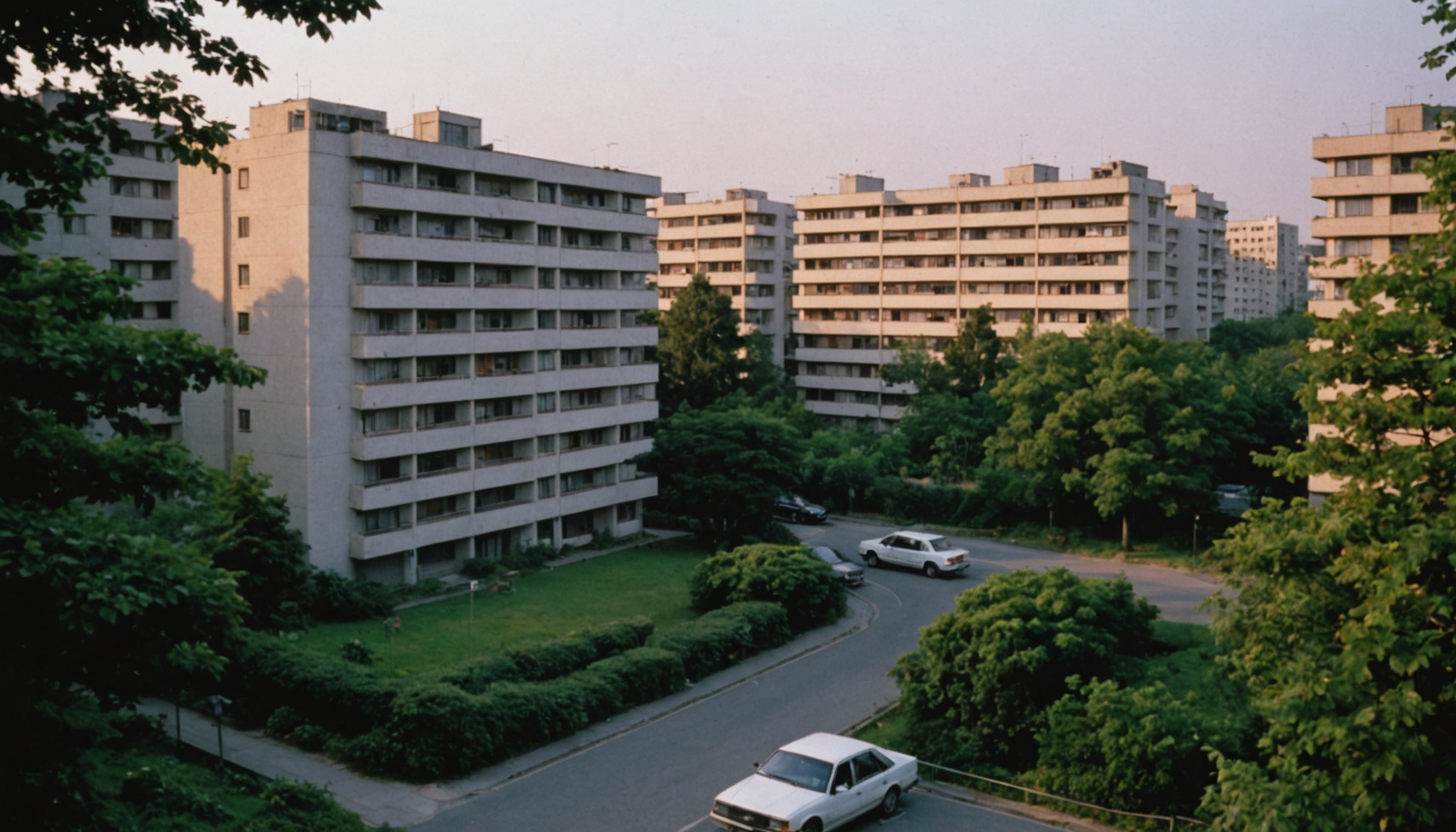
Two variables decide what members of a redevelopment association must pay in Korea's first-generation new towns: how far the standard floor area ratio (FAR) is raised, and how the public contribution charge attached to that ratio is calculated. Those two numbers set the figure before location or builder brand enters the picture.
The Ministry of Land has designated 13 districts covering 35,987 households across five new towns — Bundang, Ilsan, Pyeongchon, Jungdong and Sanbon — as pioneer districts for integrated reconstruction, targeting project implementation approval in 2026, relocation through 2027, and occupancy by 2030. In July 2026 two developments arrived at once: Seongnam City published a recalculation cutting public contribution charges for four Bundang pioneer districts by roughly 1.07 trillion won, while in Daejeon residents met with the city council over the burden of collecting consent forms all over again.
How far apart are the FAR increases?
The published redevelopment standard FARs are 326% for Bundang, 300% for Ilsan, 330% for Pyeongchon, 330% for Sanbon and 350% for Jungdong (Housing Herald). Those same figures land differently in each town because the starting point — the existing average FAR — differs. Ilsan's existing average of 169% is the lowest among the first-generation new towns, with Bundang next at 184% (Hankyung).
Working out the gap between existing and standard FAR gives the table below. The multiple is the standard FAR divided by the existing one, and the final column divides published additional supply by the increase in percentage points.
| New town | Existing average FAR (%) | Standard FAR (%) | Increase (pp) | Multiple (x) | Additional supply (units) | Units per 1pp of increase |
|---|---|---|---|---|---|---|
| Bundang | 184 | 326 | 142 | 1.77 | 59,000 | 415 |
| Ilsan | 169 | 300 | 131 | 1.78 | Not published | — |
| Pyeongchon | 204 | 330 | 126 | 1.62 | 18,000 | 143 |
| Jungdong | 226 | 350 | 124 | 1.55 | 24,000 | 194 |
| Sanbon | Not published | 330 | — | — | Not published | — |
In absolute terms Bundang's 142-point increase is the largest, but as a multiple Ilsan's 1.78 is effectively level with Bundang's 1.77. Additional supply per percentage point runs 415 units in Bundang, 194 in Jungdong and 143 in Pyeongchon. Because the existing housing stock differs by town, that figure cannot be read directly as a profitability measure. What it does show is that the density of units convertible to general sale from the same one point of FAR varies almost threefold by location — and that is the starting point for understanding the cost structure. Added FAR turns into general-sale revenue, and how much of total project cost that revenue covers determines what members must top up.
What changes when 1.07 trillion won of public contribution is cut?
Even with the same FAR, the members' share moves with the size of the public contribution charge. Seongnam City recalculated the charge for four Bundang pioneer districts, cutting a combined 1.07 trillion won. The correction fixed a method that had excluded land set aside for public contribution from the base area used to compute development density, when the rules require the whole district area to be counted; density was adjusted from 400% to 360% in the process. Individual member burdens were expected to fall by 20 to 30 million won per household (Newspim).
| District | Prior public contribution (KRW 100m) | Reduction (KRW 100m) | Reduction rate (%) |
|---|---|---|---|
| The Sibeom | 16,623 | 6,100 | 36.7 |
| Yangji Village | 10,573 | 2,800 | 26.5 |
| Saetbyeol Village | Not published | 900 | — |
| Mokryeon Village | Not published | 900 | — |
| Total | — | 10,700 | — |
The reduction rate is not uniform: 36.7% at The Sibeom against 26.5% at Yangji Village, a gap of more than ten percentage points. Districts carrying the largest prior charges were the most exposed to the calculation error — which is to say that cost conditions are not even across districts within a single new town. A counterpoint surfaced alongside the cut: with less public contribution coming in, funding for roads, water supply and other infrastructure develops a hole, so some argue the contribution requirement should extend beyond residential to commercial and business components.

The bill is not set by how much floor area ratio a district was granted, but by what remains after the deductions from it.
Why the consent forms are collected twice
Redevelopment under the special act covers housing land of at least 1 million square metres that is more than 20 years old, and a prospective special redevelopment zone requires the consent of a majority of landowners (Special Act on the Redevelopment and Support of Aging Planned Cities). Competition at the pioneer-district selection stage pushed consent rates well above that floor, and the requirement then applies again at each later stage — drawing up the special redevelopment plan, and forming the association. That is how gaps arise in which consent already gathered cannot simply carry forward.
The Daejeon Metropolitan Council held a policy roundtable on aging planned city redevelopment on 30 July. Residents raised the administrative and financial burden of re-collecting consent forms, and the council said reasonable guidelines were needed (News1). Consent collection is an early cost that never appears in the project budget, and it wears down whoever is driving the project — which is why it recurs as a cause of delay. How consent thresholds work in small-scale redevelopment is a useful contrast: see the 75% consent requirement in street-block housing redevelopment.
The remaining schedule, and what can move it
The target timeline for the 13 pioneer districts is project implementation approval in 2026, relocation and groundbreaking by 2027, and occupancy in 2030. Two points on that path connect directly to the money. First, public contribution conditions and land donation items are fixed at the implementation approval stage. Second, relocation brings loan rates on relocation financing and the state of the jeonse (lump-sum deposit lease) market into play, pulling the moment of actual payment forward.
The goal of relocating 35,987 households by 2027 is itself a variable. When relocation demand from multiple districts overlaps in one area at one time, the surrounding rental market reacts first. How the nature of the right and its tax treatment change with the stage of reconstruction is set out in the difference between occupancy rights and pre-sale rights.
What to check
Publicly available district-level material is enough to verify the items below. The first step is not to assume conditions are identical just because two districts sit in the same new town.
- The gap between the district's existing FAR and the standard FAR — local basic plans specify this district by district
- The public contribution rate, and whether contribution land is included in the base area used to compute it — this was precisely the issue in Seongnam's recalculation
- The prior public contribution amount by district — the larger the absolute figure, the greater the impact of a change in method
- Which stage a consent form is being collected for — pioneer selection, special redevelopment plan, and association formation are separate
- Whether the relocation window overlaps with neighbouring districts — the target schedule clusters them in 2027
- The construction cost basis behind any estimated contribution figure — numbers computed some time ago cannot be used as they stand
Sources
- Public contribution charges cut by a trillion won: hopes for better Bundang pioneer district economics (Newspim)
- Ilsan FAR from 169% to 300%: 140,000 more homes in the first-generation new towns (Hankyung)
- Standard FARs disclosed: Bundang 326%, Ilsan 300%, Pyeongchon 330% (Housing Herald)
- Daejeon council roundtable on pioneer districts calls for reasonable guidelines (News1)
- Special Act on the Redevelopment and Support of Aging Planned Cities (Korea Law Information Center)